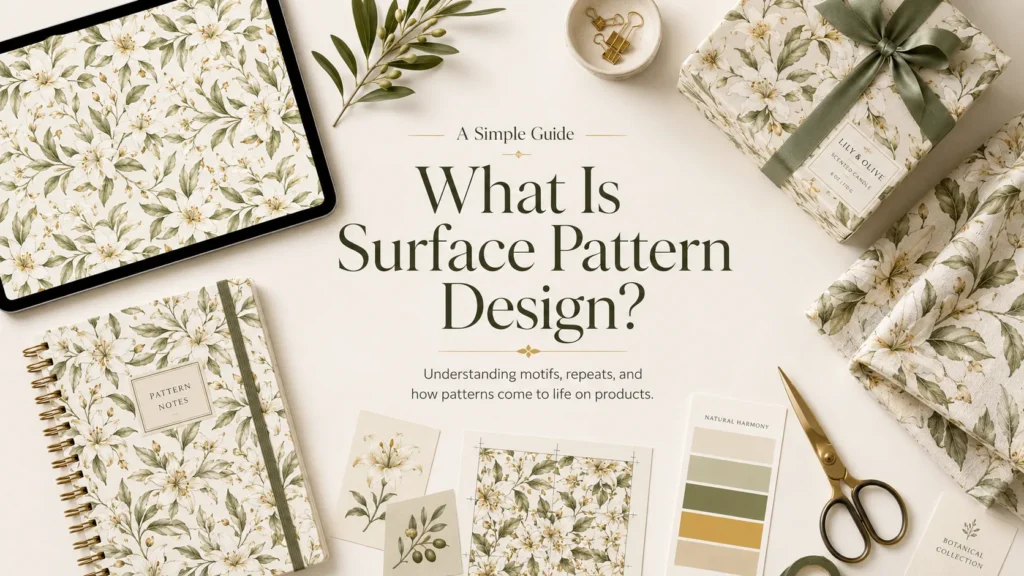
Surface pattern design is the art of creating patterns, motifs, and repeat designs that can be applied to products and surfaces.
You see surface pattern design everywhere, often without noticing it.
It appears on fabric, wallpaper, packaging, notebooks, wrapping paper, scarves, home decor, stationery, gift boxes, kitchen textiles, phone cases, bags, labels, and many lifestyle products.
A beautiful pattern can turn a simple object into something more memorable, more emotional, and more desirable.
Surface Pattern Design, Explained Simply
Surface pattern design is design made for surfaces.
Instead of creating one single artwork to hang on a wall, a surface pattern designer creates artwork that can live on real products.
The pattern may be floral, botanical, geometric, ornamental, abstract, hand-drawn, watercolor-inspired, minimal, vintage, modern, playful, or luxury.
The goal is not only to decorate.
The goal is to make a product feel more beautiful, more intentional, and more connected to a brand or collection.
What Is a Pattern?
A pattern is a design made from repeated visual elements.
These elements can include flowers, leaves, fruits, lines, shapes, ornaments, dots, animals, symbols, or abstract marks.
In surface design, these elements are usually arranged in a way that creates balance, rhythm, and visual flow.
Some patterns are bold and detailed. Others are soft and delicate. Some are made to stand out, while others are made to support a product quietly.
What Is a Motif?
A motif is one individual design element inside a pattern.
For example, in a botanical collection, a motif could be:
A flower
A leaf branch
A lemon
A small bud
A decorative ornament
A tiny filler detail
Motifs are the building blocks of surface pattern design.
A designer can use motifs alone as decorative accents, or combine them into seamless patterns, borders, placement prints, and full product designs.
What Is a Seamless Pattern?
A seamless pattern is a pattern that repeats without visible edges.
This means the design can continue endlessly in every direction. The left side connects with the right side, and the top connects with the bottom.
This is especially useful for products like fabric, wallpaper, wrapping paper, packaging, and backgrounds, where the design needs to cover a large surface.
A good seamless repeat should feel natural. You should not immediately notice where the tile starts or ends.
Where Surface Pattern Design Is Used
Surface pattern design can be used across many industries and products.
It is especially common in:
Fashion
Textiles
Home decor
Packaging
Stationery
Wallpaper
Gift wrap
Branding
Product design
Accessories
Digital products
Print-on-demand
Lifestyle goods
For example, one floral pattern can become a silk scarf, a notebook cover, a perfume box, tissue paper, a candle label, and a website background.
That is what makes surface pattern design so powerful. One strong design can support an entire product world.
Why Surface Pattern Design Matters
Surface pattern design helps products feel more complete.
A plain box can become a gift-worthy package.
A simple notebook can become a lifestyle product.
A piece of fabric can become part of a fashion collection.
A brand can feel more recognizable through repeated visual details.
Good pattern design creates emotion.
It can make a product feel calm, joyful, romantic, fresh, elegant, playful, premium, handmade, modern, or nostalgic.
This emotional layer is what makes people remember a product, choose it, photograph it, gift it, and keep it.
Surface Pattern Design and Branding
Patterns can also become part of a brand identity.
A brand does not only need a logo. It also needs a visual world.
Patterns, motifs, colors, textures, and decorative details can help create that world.
For example, a skincare brand may use soft botanical patterns to feel natural and elegant. A café may use citrus motifs to feel fresh and warm. A stationery brand may use delicate florals to feel romantic and refined.
When used well, surface patterns make a brand feel more distinctive.
They help customers recognize the brand even before reading the name.
Different Types of Surface Patterns
There are many types of surface patterns.
A hero pattern is usually the main design in a collection. It is more detailed, more expressive, and often used for statement products.
A coordinate pattern supports the hero pattern. It is usually simpler and easier to use across many products.
A ditsy pattern is a small-scale pattern with tiny repeated elements. It works well for stationery, baby products, fabric, packaging, and soft backgrounds.
A stripe or border pattern is designed for edges, trims, packaging bands, scarves, stationery borders, and product details.
A placement print is not always seamless. It is designed for a specific position, such as the center of a scarf, the front of a card, or the corner of packaging.
A strong collection often includes several of these pattern types so designers and brands can use them in different ways.
What Makes a Pattern Look Professional?
A professional pattern is not only about pretty motifs.
It needs balance, spacing, rhythm, scale, and usability.
If a pattern is too crowded, it can feel heavy. If it has too much empty space, it may feel unfinished. If the repeat is too obvious, the design can look amateur.
A strong surface pattern should feel natural when repeated. It should work on real products, not only as a square image on a screen.
Professional patterns also need a clear color palette, consistent style, and enough flexibility to be used across different product types.
Surface Pattern Design for Products
When designing for products, the pattern must be practical.
A pattern for a scarf may need a different scale than a pattern for a notebook. A pattern for wrapping paper may need more flow than a pattern for a small label.
This is why surface designers think about the final use.
They ask questions like:
Will this work on fabric?
Will it look good when printed small?
Will it still feel balanced on a large surface?
Will the motifs get cut off in a strange way?
Can text be placed over it?
Does it match the mood of the product?
Good surface pattern design is both artistic and practical.
How Surface Pattern Design Helps Creative Brands
For creative brands, surface pattern design can make products feel more valuable.
It helps create a polished product experience, from the product itself to the packaging and marketing visuals.
A pattern collection can be used for:
Product packaging
Tissue paper
Thank-you cards
Labels
Gift wrap
Website sections
Social media backgrounds
Printed products
Fabric products
Mockups and presentations
This gives the brand a more complete and professional look.
Instead of using random graphics, the brand has a consistent design language.
Digital Surface Pattern Collections
Today, many designers, makers, and brands use digital surface pattern collections.
These collections usually include seamless patterns, isolated motifs, and sometimes mockup previews or usage guides.
They are useful because they give creative businesses ready-made design assets that can be adapted to different projects.
A small business can use a digital pattern collection to create packaging, stationery, product mockups, website visuals, and printed goods without starting from zero.
The best digital pattern collections feel cohesive. The motifs, patterns, colors, and mood all work together.
Final Thoughts
Surface pattern design is more than decoration.
It is the art of making products feel beautiful, intentional, and memorable.
It connects illustration, design, branding, fashion, packaging, textiles, and product experience.
A good pattern does not simply fill space. It gives a surface character. It gives a product emotion. It helps a brand feel more complete.
For makers, designers, and creative brands, surface pattern design is one of the most powerful ways to turn a simple product into something people want to notice, use, gift, and keep.