
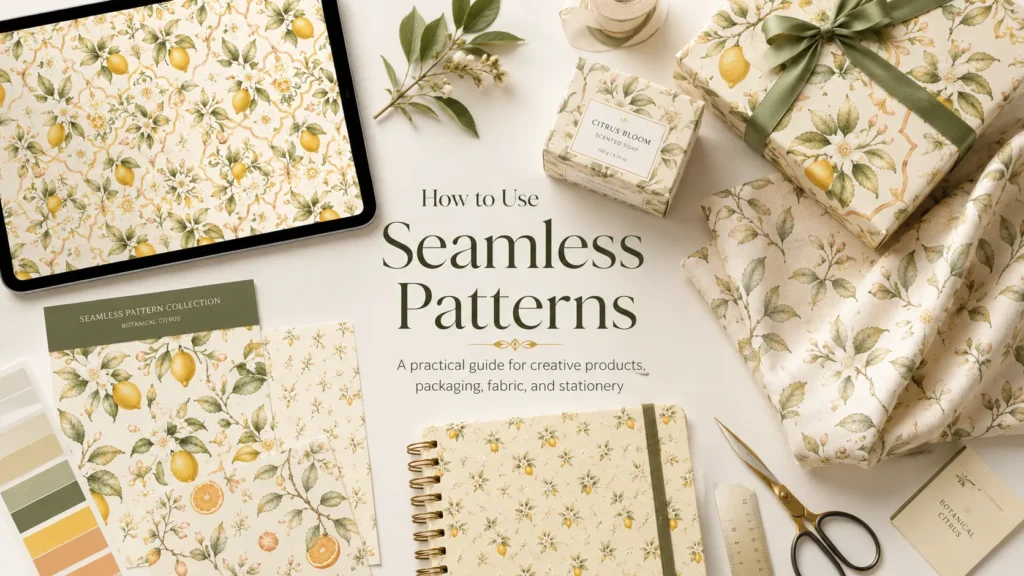
Seamless patterns are one of the most useful design assets for creating beautiful products, packaging, stationery, fabrics, and branded visuals.
A seamless pattern is designed to repeat without visible edges. This means the same tile can be placed side by side again and again, horizontally and vertically, while still looking like one continuous design.
For designers, makers, and creative brands, this is powerful. One pattern can become wrapping paper, fabric, packaging, notebook covers, product labels, social media backgrounds, website details, and much more.
What Is a Seamless Pattern?
A seamless pattern is a repeatable design file.
When the pattern is tiled, the left edge connects naturally with the right edge, and the top edge connects naturally with the bottom edge. If the repeat is made well, you should not see harsh lines, broken motifs, or obvious square borders.
This is what makes seamless patterns different from normal illustrations.
A single motif is usually one isolated design element, like a flower, lemon, leaf, ornament, or branch. A seamless pattern uses those motifs in a repeat structure, so the artwork can cover a large surface beautifully.
Why Seamless Patterns Are Useful
Seamless patterns save time and make your products look more polished.
Instead of building a background from scratch, you can use a ready-made repeat pattern and apply it directly to your product design.
They are especially useful when you need a design to cover a full surface, such as fabric, wrapping paper, packaging, wallpaper, notebooks, scarves, pouches, gift boxes, or website backgrounds.
A good seamless pattern also helps a collection feel consistent. If you use matching patterns, motifs, and colors across different products, your brand looks more professional and intentional.
Where You Can Use Seamless Patterns
Seamless patterns can be used across many creative projects.
They work beautifully for:
Packaging design
Wrapping paper
Fabric and textile design
Stationery
Notebook covers
Gift boxes
Scarves
Pouches and bags
Kitchen textiles
Labels and tags
Invitations
Website backgrounds
Social media graphics
Product mockups
Brand presentation pages
Digital planners
Scrapbooking
Print-on-demand products
The key is to choose the right scale and pattern type for each product.
A bold hero pattern can work well on a scarf, gift box, or fabric. A smaller ditsy pattern may work better for stationery, notebook covers, labels, and delicate product details.
How to Use Seamless Patterns in Your Design Software
Most design software allows you to place a seamless pattern as an image and repeat it across a surface.
You can use seamless patterns in programs such as Photoshop, Illustrator, Canva, Procreate, Affinity Designer, InDesign, or other creative tools.
The basic process is simple:
Upload or open the pattern file.
Place it inside your design.
Duplicate or tile it if needed.
Adjust the scale.
Crop it to fit your product or layout.
Export your final design.
In some software, you can also define the pattern as a repeat fill. This allows you to apply the pattern to any shape, background, or product template.
Adjusting the Scale
Scale is one of the most important parts of using seamless patterns.
The same pattern can feel completely different depending on how large or small it appears.
A large-scale pattern feels bold, expressive, and decorative. It works well for statement products such as scarves, packaging, large fabric pieces, wallpaper, or hero visuals.
A small-scale pattern feels delicate, subtle, and refined. It works well for stationery, notebook covers, pouches, labels, small packaging, and background details.
Before finalizing your product, test different scales. Sometimes a pattern that looks beautiful on screen may feel too large or too busy when printed.
Choosing the Right Pattern for the Right Product
Not every pattern should be used in the same way.
A collection usually includes different pattern types, and each one has a different role.
A hero pattern is the main statement design. It usually has the most detail and visual impact.
A coordinate pattern supports the hero pattern. It is simpler and easier to use across many products.
A ditsy pattern is small, airy, and delicate. It works well when you need a soft background.
A stripe or border pattern is useful for edges, trims, packaging bands, scarves, stationery borders, or decorative details.
A tile-inspired pattern feels more structured and ornamental. It can work well for packaging, home decor, stationery, and lifestyle products.
Using the right pattern for the right purpose makes your final product feel more professional.
Combining Patterns in One Collection
One of the best ways to use seamless patterns is to combine them as a set.
For example, you can use a hero pattern for the main product, a coordinate pattern for the packaging, and a smaller pattern for labels or tissue paper.
This creates a complete visual world.
A customer may not notice every design decision, but they will feel the difference. The product looks more considered. The brand feels more premium. The details feel connected.
This is especially useful for small brands, packaging designers, stationery makers, textile designers, and creative businesses that want a polished presentation.
Using Seamless Patterns for Packaging
Seamless patterns are perfect for packaging because they can cover boxes, bags, wrapping paper, tissue paper, labels, sleeves, and inserts.
For packaging, keep the pattern scale balanced. If the pattern is too large, important motifs may get cut off. If it is too small, the design may feel busy or lose detail.
For luxury or elegant packaging, softer patterns often work best. A little space around the motifs can make the design feel more refined and less crowded.
You can also combine patterns with simple typography, a logo, or a clean label to create a beautiful branded look.
Using Seamless Patterns for Fabric
Fabric is one of the most common uses for seamless patterns.
Patterns can be printed on cotton, linen, silk, polyester, canvas, and many other textiles.
When using patterns for fabric, always think about the final product.
A dress may need a different scale than a scarf. A cushion may need a different repeat than a pouch. A kitchen towel may look better with a medium-scale pattern than a very detailed one.
If possible, order a small fabric sample before producing a large quantity. This helps you check color, scale, sharpness, and overall feel.
Using Seamless Patterns for Stationery
Seamless patterns are also excellent for stationery products such as notebooks, planners, cards, envelopes, invitations, tags, and wrapping sheets.
For stationery, smaller and lighter patterns often work well because they do not overpower text or layout elements.
You can use patterns as full backgrounds, borders, corner details, envelope liners, notebook covers, or decorative sections.
If your stationery includes writing space, choose a softer pattern or reduce the opacity so the design remains usable.
Using Seamless Patterns for Digital Products
Seamless patterns are not only for physical products. They can also be used in digital designs.
You can use them for:
Website sections
Social media backgrounds
Digital planners
Printable templates
Brand boards
Presentation slides
Online shop banners
Email graphics
Digital invitations
For digital use, make sure the pattern does not make text hard to read. If needed, place a light overlay, use a plain section for text, or choose a softer coordinate pattern.
Important Tips Before Printing
Before sending your design to print, check a few things.
Make sure the pattern resolution is high enough for your product size.
Check that the repeat looks natural at the final scale.
Test the colors, because screens and printers can show colors differently.
Leave enough bleed area if your design will be cut or folded.
Avoid placing important motifs too close to edges, seams, folds, or holes.
Use the file format required by your printer or manufacturer.
A pattern can look beautiful on screen, but printing is the real test. A small test print can save time, money, and disappointment.
Common Mistakes to Avoid
One common mistake is using a pattern too large or too small for the product.
Another mistake is choosing a busy pattern behind important text. This can make the design hard to read.
Some people also use only one pattern across everything. This can work, but using a full collection often creates a stronger result.
It is also important not to stretch a pattern unevenly. Stretching can distort the motifs and make the design look less professional.
Finally, do not forget to check the license. Some pattern files are for personal use only, while others include commercial rights with limits.
Final Thoughts
Seamless patterns are more than decorative backgrounds.
Used well, they can help a product feel finished, memorable, and ready to sell.
They bring visual consistency to packaging, textiles, stationery, branding, and lifestyle products. They help small brands create a polished world without designing every detail from zero.
The key is to choose the right pattern, adjust the scale carefully, test before printing, and use each design with purpose.
A beautiful pattern should not only fill space.
It should make the product feel more special.