
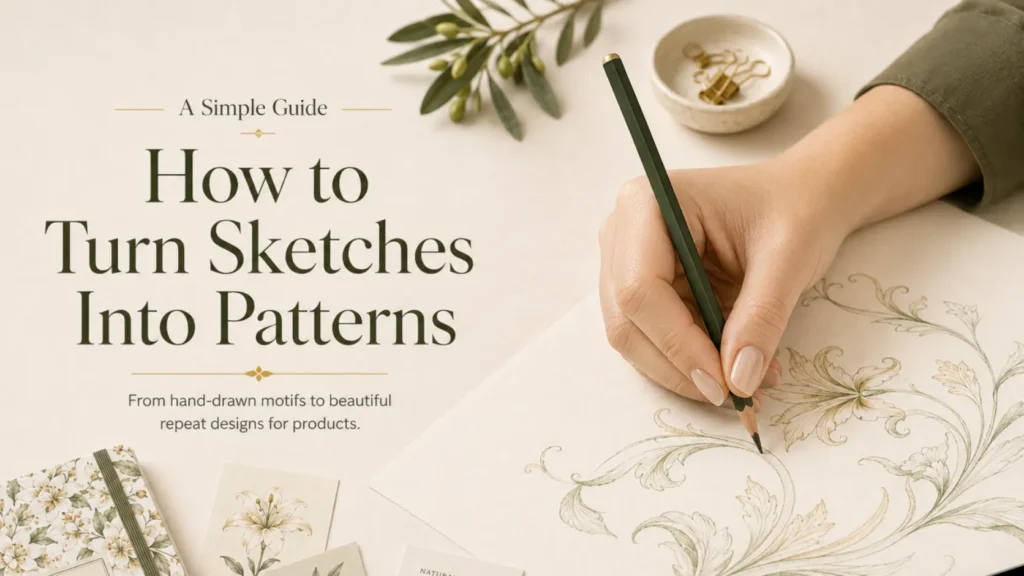
A simple sketch can become much more than a drawing on paper.
With the right process, a flower, leaf, shell, fruit, ribbon, or ornamental detail can become a repeat pattern for fabric, packaging, stationery, notebooks, scarves, labels, gift wrap, or product mockups.
This is one of the most beautiful parts of surface pattern design: an idea can begin as a small hand-drawn mark and grow into a full design world.
Turning sketches into patterns is not only about scanning a drawing and repeating it. It is about choosing the right motifs, cleaning them carefully, building rhythm, and making sure the final design feels natural on real products.
Start with a strong sketch
A good pattern starts with a sketch that has character.
It does not need to be perfect. In fact, small human details often make a pattern feel warmer and more original. A slightly uneven petal, a soft curve, or a hand-drawn line can give the final design more life than something that feels too stiff.
Before turning a sketch into a pattern, look at it carefully.
Ask yourself:
Does this motif have a clear shape?
Can it be repeated without looking too busy?
Would it work on a product, not just on paper?
Does it match the feeling of the collection?
For example, a simple lemon branch could become part of a coastal kitchen textile collection. A floral sketch could work beautifully for stationery, gift wrap, or feminine packaging. An ornamental border could become a scarf design, label detail, or luxury product insert.
Choose the right motifs
Not every sketch needs to become the main pattern.
Some drawings are better as hero motifs. Others work better as small supporting elements. A strong collection often includes both.
You may have:
A main flower
A small leaf
A fruit detail
A tiny dot or seed shape
A ribbon
A border element
A simple background filler
These smaller elements help the pattern breathe. They fill space gently without making the design feel crowded.
When building a pattern, think of your sketches like ingredients. The main motif gives the design its identity. The smaller details create balance, movement, and softness.
Clean and prepare the sketch
Once the motif is chosen, the next step is preparation.
A sketch may need to be scanned, photographed, or digitized. Then it can be cleaned so the lines, colors, and edges are ready for design use.
This does not mean removing all the human feeling. The goal is not to make the sketch look cold or mechanical. The goal is to keep its charm while making it usable.
You may need to:
Remove dust or paper marks
Adjust contrast
Refine edges
Separate the motif from the background
Correct small distractions
Prepare the file for digital layout
For digital pattern products, clean files matter. Designers, makers, and small brands need assets that are beautiful but also practical to use on packaging, fabric, stationery, and mockups.
Build a repeat layout
After the sketch is prepared, it can be arranged into a repeat.
This is where the design starts to become a pattern.
A seamless pattern means the artwork can repeat again and again without visible breaks. This is especially important for fabric, wrapping paper, wallpaper, packaging backgrounds, and digital product mockups.
The motifs need to be placed with care. If they are too close together, the pattern can feel heavy. If they are too far apart, it may feel empty. The spacing should guide the eye naturally across the design.
A good repeat has rhythm.
The viewer should not immediately see where the tile begins and ends. The pattern should feel continuous, balanced, and easy to use.
Think about scale
Scale changes everything.
A large floral motif may look beautiful on a scarf or gift box, but too big for a small label. A tiny repeat may work well for notebook covers, tissue paper, or packaging liners, but it may lose detail on a larger product.
Before finishing the pattern, test it at different sizes.
Ask:
Would this work on a small product tag?
Would it still look good on fabric?
Could it be used as a background for branding?
Does the motif lose its detail when reduced?
Does it feel too loud when enlarged?
A useful pattern should not only look good on a screen. It should feel ready for real creative use.
Create color options
Color can change the mood of the same sketch completely.
A botanical sketch in soft blush, sage, and warm ivory may feel romantic and gentle. The same motif in terracotta, olive, and deep cream may feel more Mediterranean and earthy. A coastal palette with citrus yellow, soft blue, and natural green may feel fresh and sunny.
Creating color variations gives designers and brands more flexibility.
One pattern may work for:
Spring stationery
Luxury packaging
Kitchen textiles
Children’s products
Wedding paper goods
Gift wrap
Lifestyle brand visuals
The motif stays the same, but the color story changes the feeling.
Test the pattern on real products
A pattern is not finished until it is tested in context.
Place it on mockups. Try it on a box, fabric sample, notebook cover, scarf, label, or wrapping paper layout. This helps you see if the design is truly usable.
Sometimes a pattern looks beautiful as a flat repeat but feels too busy on packaging. Sometimes a small motif looks simple on its own but becomes very charming when repeated on fabric.
Mockups help you make better decisions before publishing or selling the pattern.
They also help customers imagine the design in their own work.
Build a small pattern collection
One sketch can become one pattern.
But a group of related sketches can become a collection.
A strong pattern collection may include:
A main seamless pattern
A smaller coordinate pattern
A simple background pattern
A border or placement motif
Individual motifs for extra design use
This gives creative buyers more freedom. They can use one pattern for packaging, another for tissue paper, a motif for a label, and a coordinate design for social media or product mockups.
This is why sketch-based pattern collections can feel so rich. They are not only decorative files. They become a small visual system for products and brands.
Keep the hand-drawn soul
The most important part is not to lose the soul of the original sketch.
The digital process should make the motif more useful, not remove its personality.
A pattern that begins by hand often carries a softer feeling. It feels considered. It feels touched by someone. For creative brands, this matters because customers can feel the difference between a flat decorative background and a design that has been thoughtfully made.
At Maison Leen, this is part of the beauty of turning sketches into patterns. A small drawing can become packaging, fabric, stationery, scarves, notebooks, gift wrap, labels, or product visuals that feel more complete and memorable.
The sketch is only the beginning.
The pattern is where the idea starts to live on products.